
TL;DR:
- Cloud PLM has become democratized, accessible to SMEs with advanced features.
- It reduces costs, accelerates deployment, and facilitates secure collaboration.
- Success relies on change management, training, and strategic involvement.
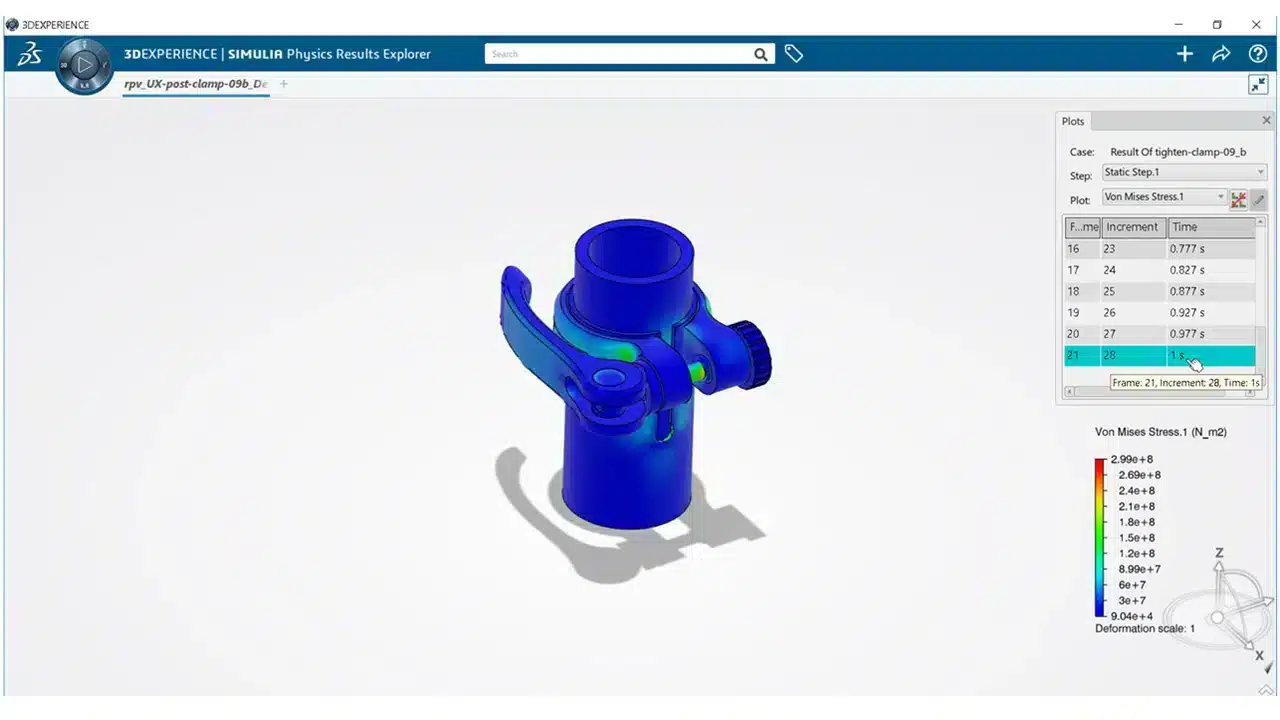
Cloud PLM (Product Lifecycle Management in the cloud) is often perceived as a tool reserved for large industrial groups with substantial budgets. This is a misconception that costs SMEs dearly. In reality, access to cloud PLM has been profoundly democratized, notably thanks to platforms like Dassault Systèmes’ 3DEXPERIENCE. Today, a mechanical engineering SME can access the same advanced features as a major account, without a massive initial investment. In this article, we explain concretely why and how cloud PLM can transform your product development processes, improve your ROI, and strengthen collaboration within your teams.
Table of contents
- Why cloud PLM is revolutionizing product management for SMEs
- Process optimization and ROI: what cloud PLM really changes
- Facilitating collaboration and data security with cloud PLM
- Adopting cloud PLM: key steps and success factors for SMEs
- What most SMEs don’t know about cloud PLM
- Take action with Ohmycad and recognized cloud solutions
- Frequently asked questions about cloud PLM for SMEs
Key Points
| Point | Details |
|---|---|
| Improved accessibility | Cloud PLM finally makes advanced tools accessible and affordable for industrial SMEs. |
| Productivity gains | Cloud PLM solutions reduce time-to-market and increase overall performance. |
| Security and collaboration | Secure data sharing acts as a catalyst for collaboration and distributed work. |
| Simplified deployment | Adopting cloud PLM is done quickly and progressively, with a visible return on investment. |
Why cloud PLM is revolutionizing product management for SMEs
For a long time, on-premise PLM (installed on the company’s internal servers) was the only serious option. This involved expensive perpetual licenses, dedicated IT infrastructure, and complex updates managed internally. For an SME of 20 to 100 people, it was often inaccessible, both financially and technically.
Cloud PLM radically changes this equation. Thanks to the SaaS (Software as a Service) model, you access the solution via the internet, with a monthly or annual subscription. No server to buy. No oversized IT department. Updates are automatic, and you always benefit from the latest version of the software.
“For industrial SMEs in mechanical engineering, cloud PLM democratizes access to advanced tools like 3DEXPERIENCE, ideal for optimizing processes without high CAPEX.”
Here is a direct comparison between the two models:
| Criterion | On-premise PLM | Cloud PLM |
|---|---|---|
| Entry cost | High (CAPEX) | Low (subscription) |
| Deployment | Several months | A few weeks |
| Updates | Manual, expensive | Automatic, included |
| Scalability | Limited, rigid | Flexible, on-demand |
| Remote access | Complex to configure | Native, secure |
| Internal IT load | High | Reduced |
Cloud collaboration thus becomes a real competitive advantage. Your design, manufacturing, and quality teams work on the same data, in real time, from any site. This shift toward the cloud is no longer a futuristic trend: it is an operational reality for hundreds of industrial SMEs in France and Europe.
The immediate benefits are tangible: rapid implementation, reduced investment cost, and the ability to scale your subscription according to your team’s growth. You pay for what you use, no more, no less.
Process optimization and ROI: what cloud PLM really changes
Let’s look at the numbers. This is often where innovation managers hesitate, for lack of concrete data to justify the project internally. Here is what industry benchmarks indicate.
According to available analyses, best-in-class companies reduce their time-to-market thanks to PLM, with a reduction in internal IT load and a measurable productivity gain from the first few months. For an SME, this translates concretely into fewer document revision errors, fewer setbacks during the prototyping phase, and better coordination between departments.
| Indicator | On-premise PLM | Cloud PLM |
|---|---|---|
| Initial deployment time | 3 to 12 months | 2 to 8 weeks |
| Total cost over 3 years | High (infra + licenses) | Predictable (subscription) |
| Estimated productivity gain | Variable | +15 to 30% (benchmarks) |
| Reduction in revision errors | Moderate | High (centralized data) |
| Internal IT load | Significant | Minimal |
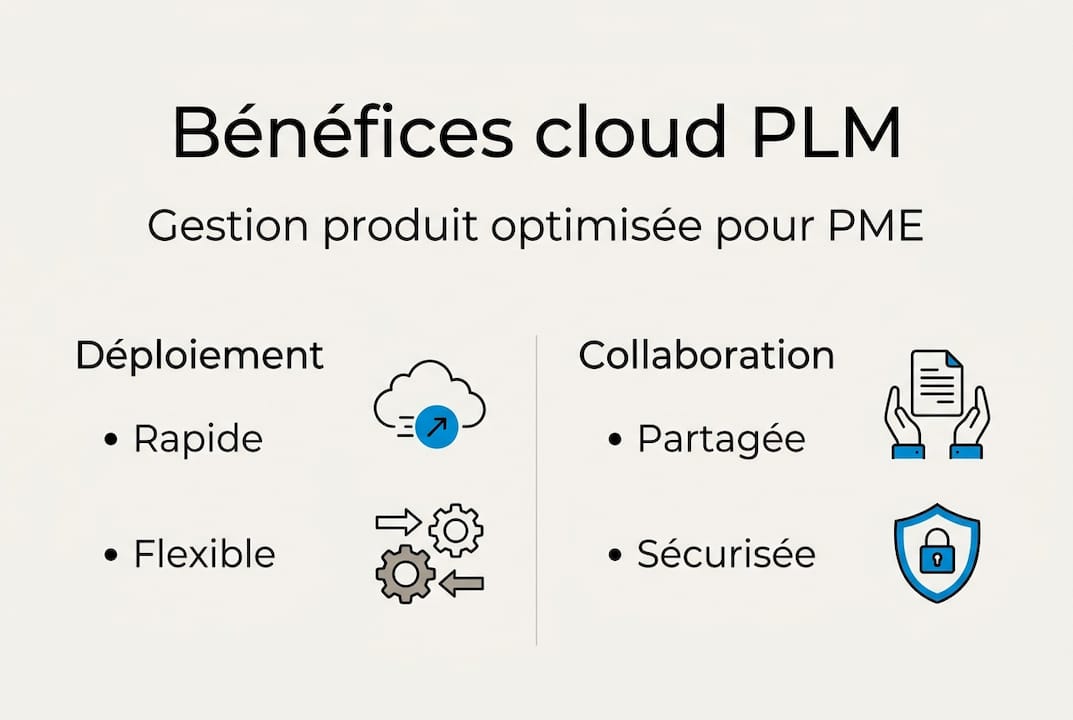
The benefits of SOLIDWORKS cloud clearly illustrate this dynamic: centralized access to product data, simplified revision management, and full traceability of changes.

Pro tip: To quickly measure the impact of cloud PLM in your SME, track three simple indicators from the first quarter: the number of document revision errors, the average time between concept validation and production launch, and the time spent by your IT team on maintaining design tools. These three metrics provide a reliable baseline for before/after comparison that is easy to present to your management.
Assembly optimization is another direct lever: with product data centralized in the cloud, version conflicts between CAD files disappear, and your engineers spend less time searching for the correct version of a component. This is time recovered for high-value-added tasks.
Facilitating collaboration and data security with cloud PLM
One of the most frequent concerns we hear from SME managers is the question of security. “Our design data is strategic. Can we really entrust it to an external host?” This is a legitimate question. Here are the answers.
Modern cloud PLM solutions, particularly those based on the cloud CAD platform 3DEXPERIENCE, natively integrate advanced security mechanisms. Scalability and outsourced IT management allow this complexity to be delegated to specialized teams, with protection levels often superior to what an SME could implement internally.
The main guarantees offered by a quality cloud PLM include:
- Data encryption in transit and at rest (AES-256 protocols or equivalent)
- Multi-factor authentication to control user access
- Granular rights management: each user accesses only the projects and documents that concern them
- Automatic backups with documented disaster recovery plans (DRP)
- Audit logs to track every modification or access
- Certified hosting (ISO 27001, SOC 2) with recognized providers
Pro tip: Before signing with a cloud PLM provider, ask them these four direct questions: Where is my data physically hosted? What is the backup retention period? What is the guaranteed restoration time in case of an incident? What security certifications do you hold? A serious provider will answer without hesitation.
For multi-site SMEs or those with subcontracting partners, cloud PLM offers a considerable additional advantage: secure remote access. Your teams in Lyon, your design office in Bordeaux, and your subcontractor in Germany work on the same data, without exchanging files by email, and without the risk of obsolete versions.
Adopting cloud PLM: key steps and success factors for SMEs
Knowing the benefits is good. Knowing how to get there without disrupting your business is better. Here are the steps we recommend for a successful transition.
- Map your current processes: Identify existing product data flows, tools used, and recurring friction points (conflicting versions, validation delays, lost documents).
- Define a pilot scope: Do not migrate everything at once. Choose a representative project or product line to test cloud PLM in real conditions.
- Select the right solution: Evaluate solutions based on your business needs, your existing CAD ecosystem, and your budget. The selection of innovative tools is a critical step that deserves expert guidance.
- Train your teams: Resistance to change is the main factor of failure. Plan a structured training program with identified internal referents.
- Measure and adjust: Track your key indicators from the first month and adjust your deployment based on field feedback.
3DEXPERIENCE subscriptions clearly illustrate this progressive approach: you can start with a limited number of licenses and expand your usage at the pace of your internal adoption, without a binding multi-year commitment. Cloud PLM is now accessible without high CAPEX, making this step-by-step approach particularly suitable for SMEs.
Three factors to monitor closely for success:
- Management involvement: without an internal sponsor at the decision-making level, the project risks stalling.
- Upfront security validation: involve your IT manager or CISO from the selection phase.
- Continuous training: one-off training is not enough. Plan follow-up sessions at 3 and 6 months.
What most SMEs don’t know about cloud PLM
We have been supporting industrial SMEs in their digital transition for several years. And here is what we regularly observe: the SMEs that succeed in their cloud PLM adoption are not those with the largest budget. They are those who understand that the real benefit is not technological, it is cultural.
Cloud PLM forces a data discipline that many teams have never really had. When everyone works on the same source of truth, behaviors change. Engineers document better. Project managers anticipate more. Decisions are made on real data, not on intuition.
Advanced uses in the automotive industry show that the most significant gains often come from this transformation of practices, much more than from the technology itself. A progressive and pragmatic approach, rather than a sudden switch, always pays off the most. Do not seek perfection from day one. Seek traction.
Take action with Ohmycad and recognized cloud solutions
You now have a clear vision of the concrete benefits of cloud PLM for your industrial SME. The next step is to find the right partner to make this transition a reality without risk. At Ohmycad, we support SMEs and innovation teams in adopting Dassault Systèmes solutions, from SOLIDWORKS to 3DEXPERIENCE CATIA, with transparent advice and certified experts by your side.
Our teams can help you evaluate your current situation, identify the most suitable solution for your context, and build a realistic deployment plan. Consult our 3DEXPERIENCE cloud CAD guide to deepen your knowledge, or explore our 3D visualization guide to discover how to enrich your product development processes. Contact us for an initial, no-obligation discussion.
Frequently asked questions about cloud PLM for SMEs
What are the implementation costs of cloud PLM for an industrial SME?
Cloud PLM eliminates the significant initial investment of on-premise solutions through subscription pricing. As confirmed by accessibility without high CAPEX, the entry cost is thus significantly reduced for SMEs.
What are the main risks when moving to cloud PLM and how can they be avoided?
Risks primarily concern data security and internal change management. Outsourced IT management to certified hosts, combined with appropriate training, effectively limits these risks.
Is cloud PLM compatible with regulatory requirements (ISO, traceability)?
Yes, major software providers offer cloud solutions compatible with ISO standards and facilitate document traceability. Advanced tools like 3DEXPERIENCE natively integrate these compliance features.
How long does it take to deploy a cloud PLM solution?
A cloud PLM deployment can be effective in a few weeks depending on the team size and internal preparation. This is much faster than on-premise solutions, thanks in particular to the democratization of advanced tools in SaaS mode.