
TL;DR:
- CAD in 2026 heavily integrates AI to analyze, correct, and generate designs in real time.
- Cloud CAD solutions, such as TopSolid and CATIA, promote collaboration, version management, and process optimization.
- Innovative tools must be selected based on their regulatory compatibility, traceability, and relevance to the production workflow.
Computer-Aided Design is undergoing an unprecedented transformation. What your teams mastered in 2024 is no longer enough to remain competitive: contextual AI is revolutionizing CAD by integrating directly into engineering workflows, changing how engineers design, simulate, and validate their products. Project managers and engineers who ignore these shifts risk creating a gap that will be difficult to close. This guide presents the major trends, innovative tools, and their practical applications to optimize your product development starting now.
Table of contents
- Context: Why CAD is Undergoing a Major Transformation in 2026
- Artificial Intelligence and Simulation: The New Backbone of CAD
- Software Updates and Machining: Focus on TopSolid, CATIA, and 3D Modeling
- Collaboration, Cloud, and PLM: Toward Networked Product Development
- Our Expert Perspective: Anticipating and Choosing the Real Winning Evolutions
- Discover the Solutions Transforming CAD
- Frequently Asked Questions About CAD Evolutions in 2026
Key Points
| Point | Details |
|---|---|
| Rise of Contextual AI | Artificial intelligence transforms CAD by offering automated suggestions and corrections that are quickly explainable. |
| Massive Cloud Adoption and Collaboration | Cloud and PLM make product management more agile, collaborative, and secure in 2026. |
| Major Software Innovations | New tools like TopSolid 2026 and GPU emissions boost performance and reduce machining times. |
| Adaptation Over Trends | Choosing solutions tailored to one’s sector and actual needs remains the key to success in the face of rapid innovation. |
Context: Why CAD is Undergoing a Major Transformation in 2026
The global CAD market is not slowing down. Driven by the rise of 3D modeling and massive cloud adoption, it is recording sustained growth that is reshaping the priorities of technical teams. Cloud CAD solutions reach 55% of the total market in 2026, a figure that illustrates the structural shift currently underway.
Several drivers explain this acceleration:
- Remote Collaboration: Multidisciplinary teams now work across multiple sites, or even multiple countries, and need access to the same digital mock-ups in real time.
- Data Explosion: An average industrial project generates significantly higher volumes of design data than five years ago, requiring more robust infrastructure.
- Strengthened Sector Requirements: Aerospace, automotive, and medical sectors impose levels of traceability and simulation that only modern platforms can handle.
- Pressure on Deadlines: Reducing time-to-market has become a competitive necessity, not a secondary objective.
| Indicator | 2022 | 2024 | 2026 (estimated) |
|---|---|---|---|
| Cloud Share in CAD Solutions | 32% | 46% | 55% |
| 3D Modeling Adoption in SMEs | 41% | 58% | 71% |
| Projects Incorporating Integrated Simulation | 28% | 44% | 62% |
Key Figure: More than 7 out of 10 industrial SMEs now use 3D modeling as a work standard, compared to fewer than 4 out of 10 four years ago.
This dynamic pushes publishers to innovate at an accelerated pace. Professionals who adopt CAD in the cloud benefit not only from increased flexibility but also from the ability to process complex assemblies without excessive hardware investment. Rising business expectations, combined with economic pressure, force every team to re-evaluate their software tools.
Now that the groundwork is laid, let’s explore the technological innovations disrupting CAD.
Artificial Intelligence and Simulation: The New Backbone of CAD
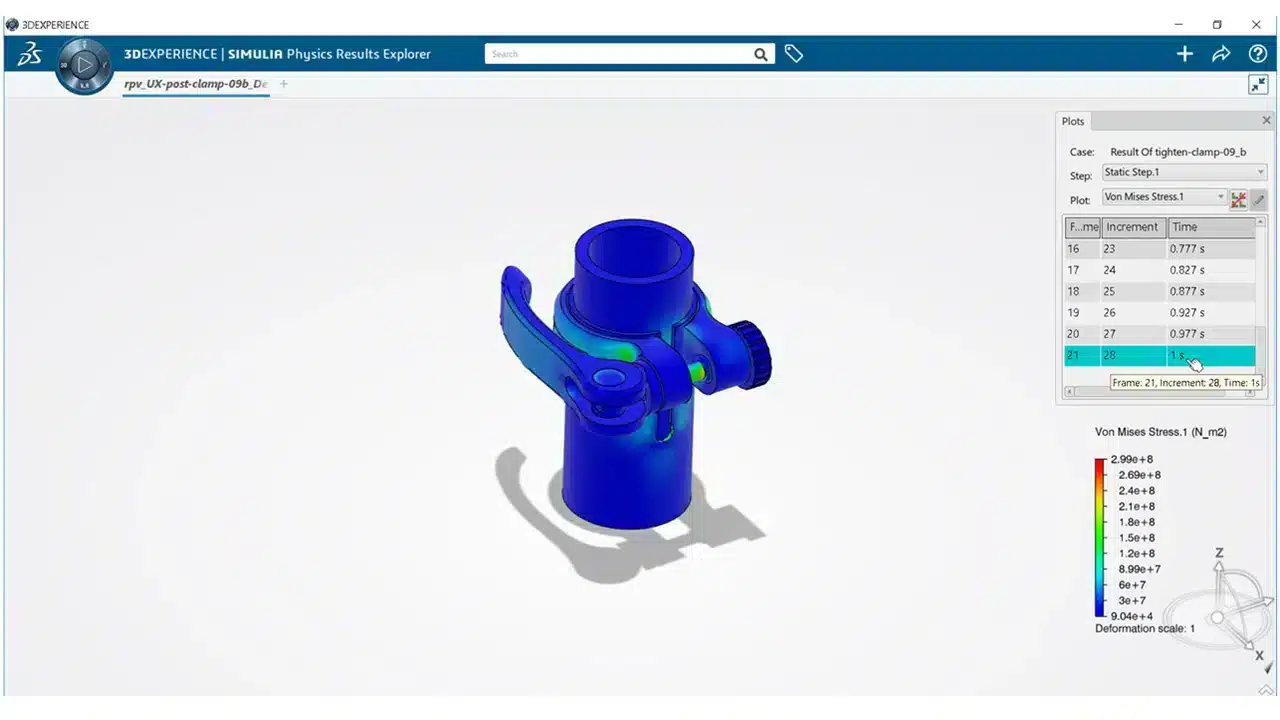
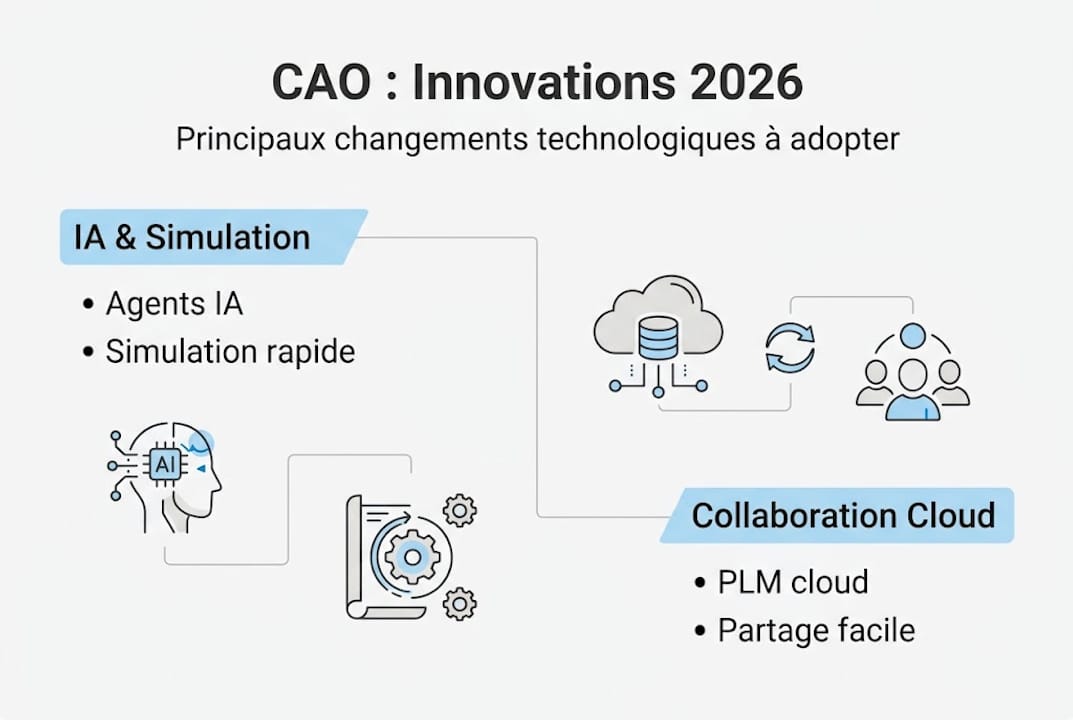
Artificial intelligence is no longer a distant horizon in mechanical engineering. In 2026, it is integrated directly into design environments in the form of specialized agents. These agents continuously analyze your models, detect geometric inconsistencies, and propose corrections even before the designer launches a manual simulation.
Concretely, here is how AI is transforming the daily lives of engineers:
- Automatic Stress Analysis: The AI agent identifies areas of structural weakness in an assembly and suggests geometry or material modifications.
- Assisted Parametric Generation: Based on functional criteria (maximum load, target weight, material cost), the AI generates several design variants to accelerate the exploration of solutions.
- Real-Time Simulation: Finite Element Analysis (FEA) calculations that used to take hours now run in minutes thanks to modern GPU architectures coupled with pre-trained AI models.
- Regulatory Consistency Check: The agent automatically verifies compliance with industry standards (ISO, EN, ASME) throughout the design process.
“AI in CAD is only effective if it is explainable. A suggestion that the engineer does not understand will be ignored, or even counterproductive.”
This question of explainability is central. The EU AI Act (European regulation on artificial intelligence) now imposes traceability requirements for AI systems used in high-risk applications, which includes many industrial contexts. CAD publishers are integrating these constraints into their interfaces by displaying the justifications for automatic suggestions.
Pro Tip: Before adopting an AI feature in your CAD tool, verify that your publisher clearly documents the logic behind each suggestion. For critical sectors like aerospace or medical, this traceability is not optional. Learning to master 3DEXPERIENCE will give you the foundation to exploit these features securely.
Once AI is adopted, which concrete tools are truly changing the game for the industry?
Software Updates and Machining: Focus on TopSolid, CATIA, and 3D Modeling
Two publishers stand out particularly this year. TopSolid 2026 introduces subdivision modeling, BoostMilling, and GPU computing, a combination that concretely changes workshop productivity. CATIA, for its part, consolidates its dominance over complex multi-body projects with reinforced collaboration tools and deeper integration into the 3DEXPERIENCE platform.

| Feature | TopSolid 2026 | CATIA V6/3DX |
|---|---|---|
| Subdivision Modeling | Yes (native) | Partial (via module) |
| Integrated GPU Computing | Yes | In deployment |
| Automated Machining (BoostMilling) | Advanced | Limited |
| Cloud-Native Collaboration | In progress | Native 3DEXPERIENCE |
| Integrated PLM Management | Partial | Complete |
Subdivision modeling deserves a quick explanation: this technique, borrowed from 3D animation, allows for the creation of complex organic shapes with precise control, ideal for aerodynamic or ergonomic parts. BoostMilling, meanwhile, is a machining algorithm that significantly reduces tool path times by continuously optimizing trajectories.
Key strengths to remember for your selection:
- TopSolid excels for industrial SMEs that combine design and manufacturing on the same site, particularly in precision mechanics and tooling.
- CATIA remains the reference for major contractors in aerospace, automotive, and defense, thanks to its native management of complex SOLIDWORKS assemblies and its robust PLM connectors.
- SOLIDWORKS continues to evolve with major innovations oriented toward simulation and collaboration, perfect for teams seeking a balance between power and accessibility.
Pro Tip: Do not choose your software based on the number of features, but on the alignment between its strengths and your actual production workflow. An oversized tool costs more in training than it saves in time.
While the tools are evolving, project methodology and collaboration are also being transformed.
Collaboration, Cloud, and PLM: Toward Networked Product Development
PLM (Product Lifecycle Management) is no longer reserved for large groups. In 2026, cloud solutions make these features accessible to SMEs, sometimes without dedicated server infrastructure. The result: complete traceability of every design decision, from the initial mock-up to final validation.
The 55% share of CAD solutions on the cloud in 2026 is no accident. This massive adoption is explained by very concrete benefits:
- Reduction in Version Errors: No more files sent by email with ambiguous names; every modification is timestamped and attributed to a specific user.
- Multidisciplinary Collaboration: Mechanical, electronic, and software teams access the same digital model in real time, which accelerates design reviews.
- Licensing Flexibility: SaaS (Software as a Service) models allow for adjusting the number of users according to project phases.
| Cloud PLM Advantage | Measured Impact |
|---|---|
| Reduction in Version Conflicts | Up to 70% less |
| Design Review Time | Halved on average |
| IT Infrastructure Cost | Reduced by 30 to 50% |
However, obstacles exist. Subscription costs can surprise SMEs accustomed to perpetual licenses. Dependence on a single publisher (the famous vendor lock-in) is a real risk, as are data sovereignty issues for sensitive projects.
To move forward confidently, here are the best practices to adopt: demand exports in open formats (STEP, IGES), negotiate portability clauses in your contracts, and train your teams to use the 3D visualization types suited to each project phase. The benefits of cloud PLM for SMEs are real, but they require serious preparation.
After this operational overview, it is time to provide expert insight into the reality on the ground.
Our Expert Perspective: Anticipating and Choosing the Real Winning Evolutions
Every year, new technologies are presented as revolutionary. Our experience with industrial companies teaches us one thing: most adoption failures do not come from a bad tool, but from a tool ill-suited to the company’s actual context.
AI in CAD is the perfect example. The promises are real, but the opacity of certain algorithms remains incompatible with the traceability requirements of critical sectors. In aerospace or medical, an undocumented suggestion cannot be accepted in a certification file. Choosing an AI tool without verifying its level of explainability is taking a concrete business risk.
Our recommendation is simple: evaluate each innovation based on three criteria: its direct contribution to your production workflow, its compatibility with your regulatory obligations, and the reality of publisher support in case of problems. Consult our selection of innovative CAD tools to get started on the right foot, without getting swept away by technological marketing.
Discover the Solutions Transforming CAD
You now have a clear vision of the trends redefining CAD in 2026. The next step is to implement them in your organization. Whether you want to explore advanced 3D visualization, structure your product lifecycle management, or understand why CATIA is essential for major industrial projects, we are here to support you.
Our team of experts guides you in choosing solutions tailored to your sector and your actual constraints. Consult our 3D visualization guide to structure your design reviews, discover why success with CATIA depends on expert support, and explore the cloud PLM benefits for your SME. Contact us for an initial consultation without obligation.
Frequently Asked Questions About CAD Evolutions in 2026
What are the concrete contributions of AI in CAD for an industrial company in 2026?
Contextual AI agents accelerate error detection, propose automatic improvements, and facilitate compliance with industry standards, provided that their suggestions are explainable and traceable.
Which CAD software programs are at the forefront in 2026?
TopSolid and CATIA stand out in particular, with major innovations such as subdivision modeling and BoostMilling for TopSolid, and cloud-native collaboration for CATIA via the 3DEXPERIENCE platform.
How has Product Lifecycle Management (PLM) evolved with the cloud?
Cloud PLM offers real-time collaboration and better traceability; with 55% of CAD solutions now hosted in the cloud, it also reduces version errors and IT infrastructure costs.
What are the main obstacles to adopting new CAD technologies?
High costs and dependence on publishers remain the major obstacles, along with the need to train teams on deeply renewed interfaces and working methods.