
TL;DR:
- The 3D design review must be structured, integrating visual, functional, calculated, and standardized control.
- Proper preliminary organization, standards, and appropriate tools are essential to limit errors and costs.
- Multidisciplinary communication and risk management are key to an effective review in SMEs.
A non-compliant part discovered during the manufacturing phase can cost between five and twenty times more to correct than an error identified during the design phase. For an industrial SME, this type of delay can compromise a launch, damage a client relationship, or inflate an already tight budget. Yet, the 3D design review often remains improvised, reduced to a quick glance at the model, without method or evaluation grid. This guide offers you a structured, pragmatic approach adapted to the realities of SMEs to transform your design review into a true lever for innovation and reliability.
Table of contents
- Defining the 3D Design Review: Objectives and Challenges
- Preparing Your Review: Organization, Tools, and Standards
- Key Steps to Effectively Manage a 3D Design Review
- From Control to Action: Validating and Improving Your Design
- The Truth About 3D Design Reviews in SMEs: What No One Tells You
- Need to Go Further in Mastering 3D Design Review?
- Frequently asked questions
Key Points
| Point | Details |
|---|---|
| Rigorous Preparation | A well-prepared and documented model eliminates 80% of review errors. |
| Standards and Templates | The use of templates and international standards reduces misunderstandings during the transition to manufacturing. |
| Clear Sequential Steps | Following standard steps ensures nothing is overlooked and accelerates validation. |
| Results Interpretation | Knowing how to identify mechanical deviations enables rapid and targeted correction. |
| Promote Team Dialogue | Involving the team from the review stage improves innovation and final robustness. |
Defining the 3D Design Review: Objectives and Challenges
The 3D design review is not a simple visual verification. It is a structured process that aims to confirm that the digital model meets functional requirements, manufacturing constraints, applicable standards, and expected mechanical performance. In short, a well-conducted review answers four major questions: Does the part comply with the specifications? Can it be manufactured under the planned conditions? Will it withstand service loads? And is the associated documentation complete and readable by all stakeholders?
For an SME, the challenge is twofold. It is necessary to both limit manufacturing returns, non-conformities, and costly iterations, while maintaining a lightweight process that does not paralyze project progress. This is where the real difficulty lies: finding the right level of formalism, neither too light at the risk of letting errors through, nor too heavy at the risk of slowing down the teams.
Here are the main control levels to integrate into your review:
- Visual Control: geometric consistency, absence of interferences, modeling quality
- Functional Control: verification of expected behavior (clearances, assembly, kinematics)
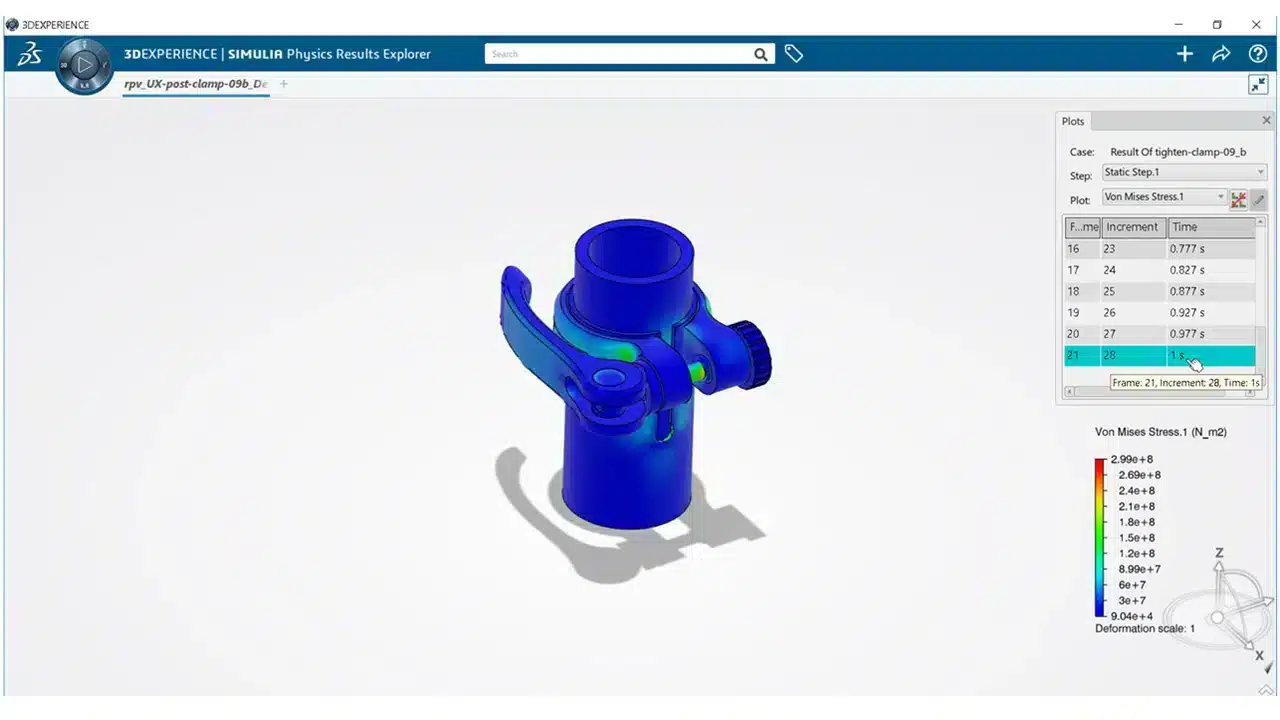
- Calculated Control: simulation of stresses, displacements, thermal behavior under actual loads
- Standardized Control: compliance with ISO, ASME standards, or company internal specifications
As highlighted in 5 common errors in SOLIDWORKS simulation: a review must not be limited to the visual aspect. Preparation errors, load definition errors, and mesh quality issues are those that make analysis results inaccurate. The review must therefore integrate consistency checks, convergence verification, and ideally independent validation for critical cases.
| Control Level | Tools Involved | Risk if Omitted |
|---|---|---|
| Visual | 3D Viewer, SOLIDWORKS | Undetected interferences |
| Functional | SOLIDWORKS Motion, assemblies | Malfunction in service |
| Calculated | SOLIDWORKS Simulation, CATIA | Failure, over-dimensioning |
| Standardized | Templates, style guide | Client or standard non-compliance |
To go further in structuring your digital environment, mastering 3DEXPERIENCE represents a natural step to centralize and ensure the reliability of your review data.
Preparing Your Review: Organization, Tools, and Standards
Even before opening the first file, the quality of a 3D design review depends on the quality of preparation. A poorly named model, an incomplete bill of materials, files from unvalidated sources: each of these points can invalidate hours of work. Upstream organization is not a luxury reserved for large corporations. It is an accessible and essential discipline for any SME that wants to progress.
Here is the checklist of essential prerequisites before starting a review:
- Verify that all CAD files come from validated and up-to-date sources
- Ensure that associated documentation (drawings, bills of materials, specifications) is complete
- Define review participants and their roles (designer, methods, quality, client)
- Select and share the company’s internal template or style guide
- Identify applicable standards for the project (ISO, ASME, sector standard)
- Prepare a shared workspace to centralize observations
Efficient CAD file organization is the foundation on which any reliable review rests. A well-structured file tree, with clear naming conventions, significantly reduces the risk of using an obsolete version during the review.

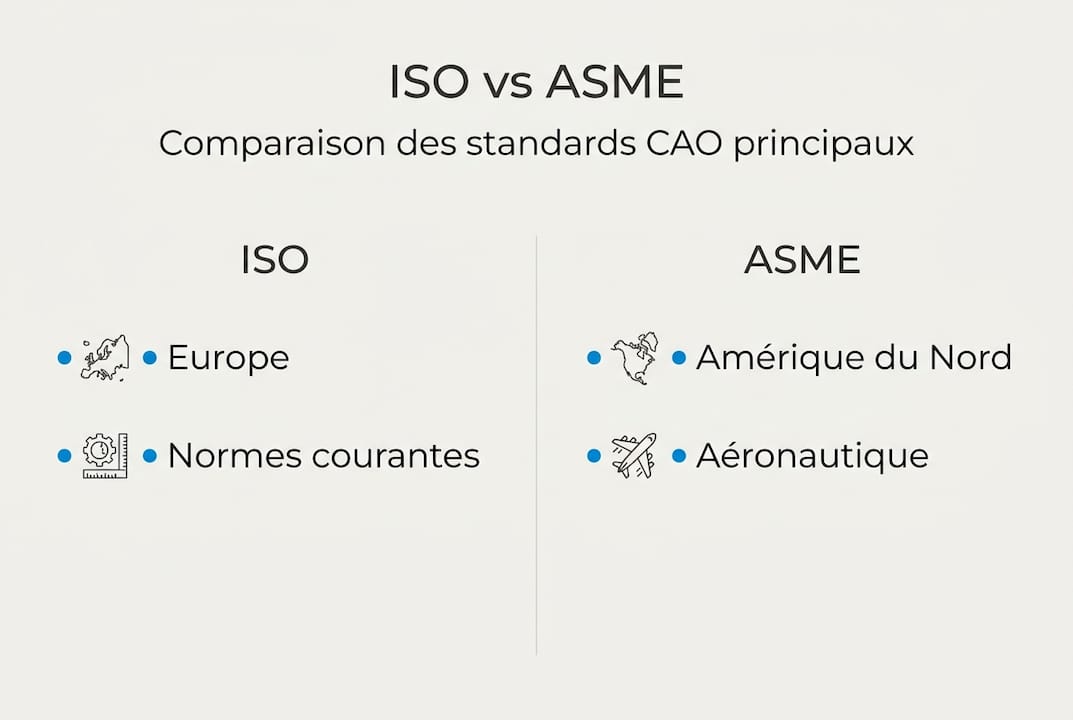
Regarding standards, the choice between ISO and ASME is not neutral. ISO is predominant in Europe and international markets, while ASME prevails in North American or aerospace projects. Projection standards notably define graphic representation conventions and must be applied consistently across all associated drawings.
| Criterion | ISO | ASME |
|---|---|---|
| Main Geographic Area | Europe, international | North America, aerospace |
| Preferred Projection | First angle (European) | Third angle (American) |
| Geometric Tolerances | ISO 1101 | ASME Y14.5 |
| French SME Adoption | Recommended | If client or market requires it |
As highlighted in 7 fatal errors in 3D CAD, alignment with formats, modeling conventions, and validated templates is explicitly recommended to avoid errors that cause delays and manufacturing problems.
Pro tip: Create a review template specific to your company, with mandatory fields (reference, version, date, validator) and checkboxes. This document becomes a communication tool as well as a control tool. Share it in advance so that each participant arrives prepared.
Key Steps to Effectively Manage a 3D Design Review
Now that the organization is in place, let’s see how to conduct the review step by step. The objective is to progress sequentially, from the simplest to the most demanding control, never moving to the next step without having validated the previous one.
-
Standardized Control: start by verifying the visual compliance of the model. Check geometric consistency, absence of interferences between parts, completeness of the bill of materials, and readability of associated drawings. This first pass quickly eliminates basic errors before engaging calculation or simulation resources.
-
Verification of Loads and Connections: if the project involves mechanical parts subjected to loads, verify the definition of boundary conditions before any simulation. Supports, applied loads, connections between parts—all of this must correspond to the actual operating reality. A poorly defined connection invalidates the entirety of the results.
-
Mesh Analysis and Convergence: for finite element simulations, mesh quality is critical. A mesh that is too coarse can mask critical stress concentrations. Systematically perform a convergence analysis: rerun the calculation with a refined mesh and compare the results. If the values change significantly, your first result was not reliable.
-
Validation by Alternative Calculations or Tests: for parts with critical stakes (safety, regulatory compliance, guaranteed performance), do not rely on a single simulation. Cross-check results with simplified analytical calculations, expert opinion, or plan physical tests on prototypes. This is a step that many SMEs skip due to lack of time, and which costs them dearly during initial production runs.
To optimize complex assemblies, the review must be integrated from the design stage, not only at the end. An assembly reviewed early costs infinitely less to correct than an assembly reviewed after parts manufacturing.
Pro tip: Document each review step with annotated screenshots, timestamped comments, and references to specification sections. This traceability protects you in case of dispute, accelerates revisions, and facilitates onboarding of new collaborators on the project.
Implementation on CAD workstation concretely shows how an engineer integrates these steps into their daily workflow, from 3D visualization to final validation.
From Control to Action: Validating and Improving Your Design
Conducting a review is one thing. Knowing what to do with the results is another. Too often, observations remain in a shared file without anyone being clearly responsible for corrections. An effective review always ends with an action list, with a responsible person and a deadline for each item.
How do you know if a design is truly ready? Ask yourself these key questions:
- Have all open items from the previous review been addressed and validated?
- Are the simulation results consistent with the specification requirements?
- Are the drawings and bill of materials up to date and readable by the subcontractor or manufacturer?
- Is the definition file sufficiently documented to allow unambiguous manufacturing?
One particular case deserves special attention: parts manufactured by 3D printing. The mechanical properties of printed parts may be inferior to those of machined parts in certain areas, with heterogeneity related to manufacturing parameters (print orientation, post-curing, material nature). This means that simulation results based on “standard” material properties may not reflect the reality of the actual part.
| Criterion | Machined Part | 3D Printed Part |
|---|---|---|
| Mechanical Strength | High, isotropic | Variable depending on orientation |
| Repeatability | High | Depends on machine parameters |
| Surface Condition | Controllable | Higher roughness |
| Cost for Small Series | High | Competitive |
| Qualification Need | Standard | Characterization recommended |
To qualify your 3D files before production, there are structured methods that reduce uncertainties and document design choices in a traceable manner.
The improvement loop must be rapid and iterative. After each review, prioritize corrections by impact level (safety, functionality, aesthetics, cost), address them in this order, then schedule a closing review to validate the modifications. This short and disciplined process is better than a long annual review that blocks all project progress.
Key takeaway: according to an analysis of 38 studies on additive manufacturing, the variability of mechanical properties of 3D printed parts is attributed notably to the materials used, print orientation, and applied post-treatments. For any product with critical stakes, a physical characterization campaign remains essential, even if the digital model seems perfect.
The Truth About 3D Design Reviews in SMEs: What No One Tells You
After years of supporting industrial SMEs in their design projects, we want to share a conviction that is somewhat uncomfortable: tools do not make the review. The review is first and foremost a dialogue.
You can have SOLIDWORKS Simulation, a 3DEXPERIENCE license, and a perfect template, and yet fail a review if the designer, methods manager, and manufacturer do not speak the same language. The most costly errors we have observed did not come from poor software. They came from a lack of communication between design and the field. A misunderstood loading assumption, a tolerance that the subcontractor cannot hold, a part orientation that changes everything about actual strength.
This is why we believe that frequent short design reviews are better than a single comprehensive validation. Five short, multidisciplinary reviews are better than one large final review where everyone validates out of fatigue. Involve the manufacturer from the design phase, ask uncomfortable questions early, accept that the model may be challenged.
For certain 3D printed products, edge cases of mechanical performance related to orientation, post-treatment, and material heterogeneity can lead to significant deviations compared to a machined part. A design review that ignores this factor would expose the product to real risk in service. It is not enough to simulate: you must test, document, and decide with full knowledge of the facts.
Finally, accept uncertainty as part of the process. An SME does not always have the resources to test all edge cases. But it can document what it knows, identify what it does not know, and build a realistic risk strategy. This assumed pragmatism is often more valuable than an apparently perfect validation. 3D configurators are precisely an example of tools that help quickly formalize variants and reduce uncertainty without multiplying review cycles.
Need to Go Further in Mastering 3D Design Review?
You now have a clear vision of the steps, tools, and pitfalls to avoid to manage a solid 3D design review. But the method is not always enough: you also need the right tools, properly configured, adapted to your size and your projects.
At Ohmycad, we support startups and industrial SMEs in deploying proven CAD solutions, from software selection to operational implementation. Whether you want to deepen your mastery with the 3DEXPERIENCE guide or explore our selection of innovative CAD solutions adapted to SMEs, we are here to help you ensure the reliability of your next reviews and accelerate your product development. Contact our team for a personalized discussion with no obligation.
Frequently asked questions
What are the common pitfalls during a 3D design review?
Forgetting to validate model preparation and neglecting mesh quality are two common pitfalls that lead to major errors difficult to detect without a structured method.
What is the difference between visual and mechanical validation in the review?
Visual validation detects basic geometric compliance, while mechanical validation requires verifying robustness under actual loads. Preparation errors (loads, connections, mesh) are precisely those that visual validation cannot identify.
Is it mandatory to apply ISO or ASME standards in SMEs?
The application of international standards is strongly recommended to avoid interpretation errors and facilitate collaboration with your partners, even for a small organization.
What should you do if 3D prototype results are highly variable?
A thorough review must analyze manufacturing parameters (orientation, material, post-curing) and, in case of critical stakes, plan a characterization campaign or specific tests on representative specimens.
How do you effectively document a 3D design review?
Gather all observations, blocking points, and modification proposals in a shared file or dedicated tool, with a responsible person and a deadline for each action, to ensure traceability and effective closure of each item.