
TL;DR:
- Keeping 3D design in-house is not always cheaper for SMEs, due to hidden costs and maintenance. Outsourcing provides rapid access to cutting-edge technologies while freeing up time for innovation and business development. Choosing a reliable partner and defining clear processes ensures control, flexibility, and strategic success.
Many SME and industrial startup leaders assume that keeping 3D design in-house is cheaper. This is a misconception that deserves serious questioning. In reality, focusing innovation on core business while accessing cutting-edge technologies without bearing the burden of obsolescence represents a significant competitive advantage. This guide helps you objectively measure the true costs of in-house operations, compare both approaches, and identify concrete levers for intelligently outsourcing your 3D design.
Table of contents
- The Challenges of In-House 3D Design for SMEs
- Comparison: In-House vs. Outsourced 3D Design
- Accessing the Latest Technologies Without Heavy Investment
- Business Focus: Realigning Your Teams to What Matters Most
- Maximizing Efficiency and Flexibility: How to Choose Your Outsourcing Partner
- Our Perspective: Strategic Outsourcing, an Underestimated Agility Lever
- Seize the Benefits of Outsourcing with Ohmycad
- Frequently Asked Questions About 3D Design Outsourcing
Key Points
| Point | Details |
|---|---|
| Fewer Hidden Costs | Outsourcing 3D eliminates the purchase and maintenance of expensive hardware. |
| Access to the Latest Innovations | You benefit from advanced technologies without initial investment. |
| Focus on Core Business | Your teams concentrate on innovation and product development. |
| Increased Flexibility | Outsourcing allows for rapid adjustment of workload based on needs. |
The Challenges of In-House 3D Design for SMEs
One observation is clear: bringing 3D in-house does not always equate to agility or budget control. Before deciding, it’s essential to face the numbers and move beyond preconceived notions.
Costs That Discreetly Accumulate
The first often underestimated expense is the acquisition of software licenses. A SOLIDWORKS seat, for example, costs several thousand euros to purchase, plus annual maintenance contracts. CATIA, used in more demanding sectors like aerospace or automotive, reaches even higher cost levels. Few SMEs anticipate this volume of expenditure over three to five years.
Furthermore, efficient 3D modeling methods require high-performance computer hardware: dedicated workstations, high RAM, professional graphics cards. This equipment needs renewal and maintenance. Not to mention that breakdowns always occur at the worst possible time, such as when a prototype needs to be delivered within 48 hours.
“Avoiding costly hardware investment and its maintenance is one of the most direct benefits of outsourcing.”
Here are the main obstacles faced by SMEs that internalize their 3D design:
- High and recurring CAD license acquisition costs, with essential updates
- Maintenance of powerful IT equipment, often underestimated in terms of time and budget
- Permanent training investment to keep teams up-to-date on new features
- Risk of skill gaps if a key engineer leaves the company or is absent
- Difficulty keeping pace with technology from publishers like Dassault Systèmes, who release major updates annually
The reality is that these hidden costs transform an apparently stable budget item into a much heavier actual expense than anticipated.
Comparison: In-House vs. Outsourced 3D Design
Based on these challenges, it is relevant to objectively compare the two strategies. Here is a summary table to help you position yourself.
| Criterion | In-House | Outsourcing |
|---|---|---|
| Initial Cost | High (licenses, hardware) | Low (on-demand service) |
| Flexibility | Limited to internal resources | High, scalable according to projects |
| Access to Innovation | Depends on renewal budget | Immediate, provided by the service provider |
| Speed of Start-up | Long (recruitment, training) | Short (start-up in a few days) |
| Available Expertise | Variable depending on the team | Access to specialized profiles |
| Risk of Obsolescence | High | Almost zero for the client |
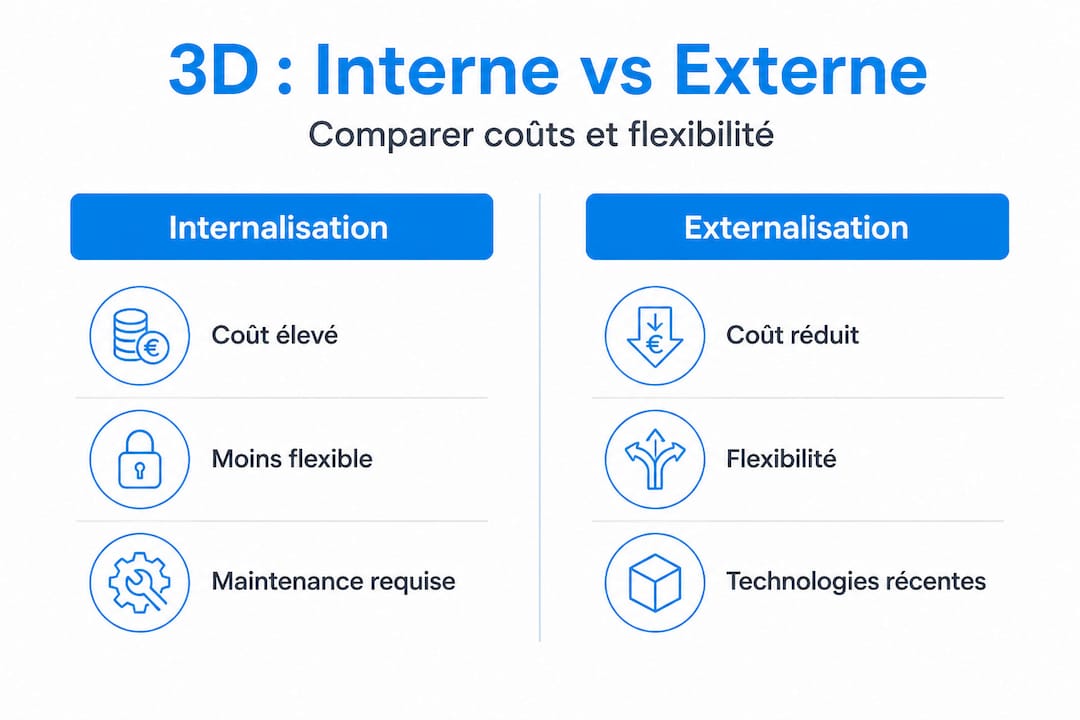
Focusing on core business and accessing recent technologies without suffering obsolescence are among the strongest arguments for outsourcing for industrial SMEs.
What outsourcing concretely minimizes:
- Unforeseen investment cycles related to software updates
- Dependence on one or two internal experts
- Onboarding times for new projects
To unlock the potential of 3D configurators or integrate new digital solutions, outsourcing offers a quick entry point without mobilizing your capital.
Pro Tip: Outsourcing avoids unforeseen investment cycles. To anticipate your costs, always ask your service provider for a multi-year quote with a simulation of technological evolution scenarios. You will be able to budget precisely, without unpleasant surprises.
Accessing the Latest Technologies Without Heavy Investment
The advantages of outsourcing become striking when considering innovation and technology. The economic logic is simple yet powerful: a specialized service provider amortizes its licenses, servers, and training across all its clients. This way, you benefit from high-end solutions at a fraction of the cost.
Immediate Access to Cutting-Edge Tools
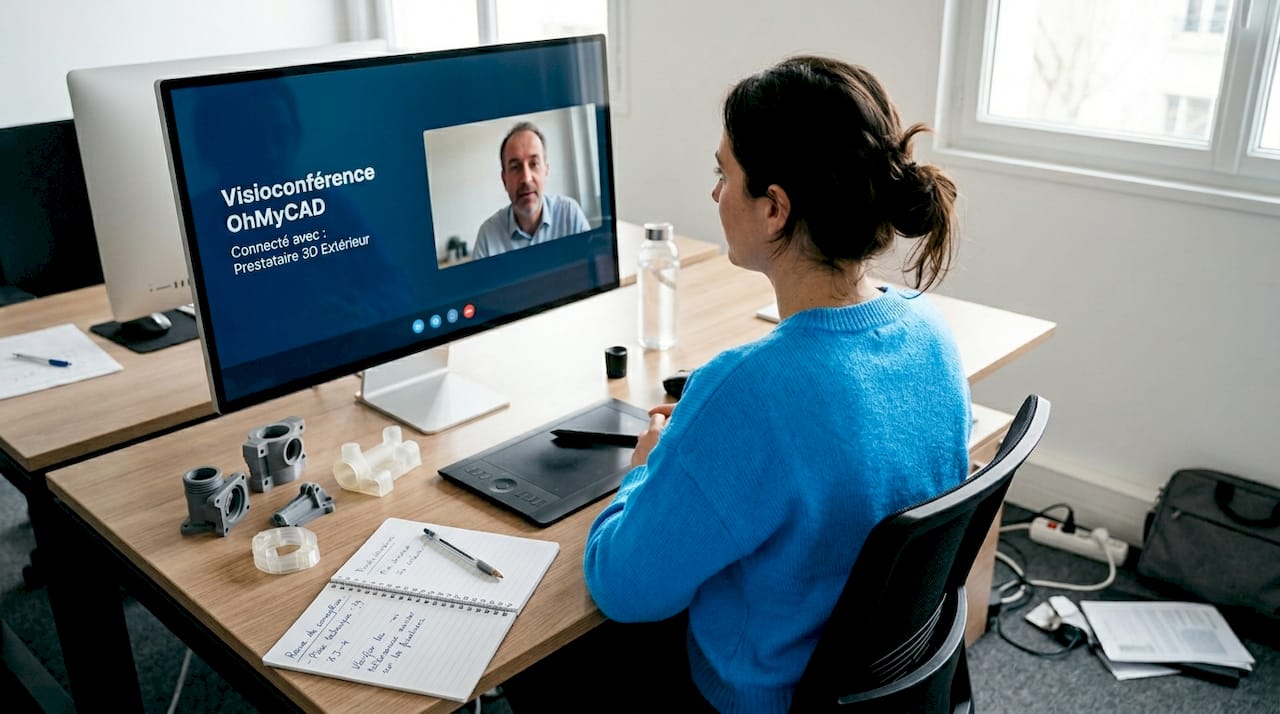
Imagine being able to work with an expert equipped with SOLIDWORKS Premium, CATIA V6, or Dassault Systèmes’ 3DEXPERIENCE platform, without spending a single euro on licenses or infrastructure. This is exactly what outsourcing allows. You order a service, you receive deliverables in native or universal format, and your cash flow remains intact.
Flexibility is also a major asset. You can test new software solutions or new modeling approaches, such as finite element simulation or generative design, without long-term financial commitment. If a technology doesn’t suit your project, you change your approach without loss.
| Technology Type | Estimated Internal Cost (annual) | Via Outsourcing |
|---|---|---|
| SOLIDWORKS License + Maintenance | €5,000 to €8,000 | Included in service |
| Professional Workstation | €2,000 to €5,000 (depreciation) | Borne by service provider |
| Training for New Versions | €1,000 to €2,500/year | Transparent for the client |
| Advanced Simulation Access | €4,000 to €10,000 | A la carte |
Recent technologies accessible without obsolescence represent a direct lever for competitiveness for SMEs that cannot afford to renew their software park every year.
Field studies show that 70% of SMEs observe an immediate modernization of their processes after outsourcing their 3D design. They gain access to methods and tools that their competitors, still operating in-house, have not yet adopted.
Pro Tip: Before signing with a service provider, precisely verify which software and version they use. A partner still working on obsolete versions will not provide you with the expected productivity gains. Request a contractual list of the tools used and their update frequency.
Business Focus: Realigning Your Teams to What Matters Most
Beyond technology, it’s also about making better use of your human resources. This is often where the most significant gains lie, though they may be less visible at first.
Unleash Your Teams’ Creative Energy
When your engineers spend time managing software failures, attending training, or troubleshooting technical CAD issues, they are not designing. They are not interacting with your clients. They are not imagining the next product. Outsourcing gives them back this valuable time.
“Focusing on core business allows internal teams to dedicate themselves to what they do truly well: innovating, selling, improving.”
Here are the steps to organize a successful refocusing after outsourcing your 3D design:
- Map current tasks of your technical teams and identify those that fall directly under outsourceable CAD
- Clearly define expected deliverables from the service provider (formats, standards, deadlines, detail levels)
- Establish a single internal point of contact to manage the relationship with the service provider and ensure project consistency
- Schedule regular validation points to ensure models meet your functional and aesthetic requirements
- Reallocate freed-up resources to high-value-added activities: R&D, customer relations, business development
The application of these principles in the automotive industry, for example, shows that teams relieved of operational CAD tasks significantly accelerate the time-to-market for new models. The same logic applies to your industrial products, whether they are machines, components, or mechatronic systems.
The reduction in operational stress is a rarely mentioned but real benefit. Your teams are no longer under constant pressure to meet impossible deadlines with limited internal resources. They regain serenity and creativity. This human factor has a direct impact on talent retention, a crucial issue for industrial SMEs.
Maximizing Efficiency and Flexibility: How to Choose Your Outsourcing Partner
Outsourcing is only successful if it relies on a reliable partnership tailored to your industry and ambitions. Choosing the wrong service provider can turn a competitive advantage into a source of complications. Here are the criteria that truly make a difference.
Essential Selection Criteria
Focusing on your core business only becomes effective if your partner perfectly masters the technologies and constraints of your industrial sector. A mechanical design specialist will not necessarily be the right choice for a plastics or aerospace project.
Here are the points to systematically evaluate before signing:
- Sectoral experience: ask for references in your specific industrial domain, not just generic achievements
- Transparency on costs and deliverables: a good service provider gives you a detailed statement of work before any start, with no gray areas
- Responsiveness and communication: test response speed from the consultation phase. If communication delays are long even before signing, they will be even longer during the project
- Mastery of appropriate software: verify that the service provider uses solutions compatible with your environment (SOLIDWORKS, CATIA, or cloud tools like 3DEXPERIENCE)
- Ability to lead design review: a solid service provider knows how to lead the design review and effectively involve you at each key stage
Recognized optimization practices in the industry show that the quality of the partnership relies more on the clarity of initial commitments than on the volume of services offered.
Pro Tip: Demand concrete examples of achievements in your sector and precise commitments on deadlines. A serious service provider will not hesitate to provide you with a detailed portfolio and propose a test phase on a small-scale pilot project. This is the best way to evaluate the relationship without major risk.
Our Perspective: Strategic Outsourcing, an Underestimated Agility Lever
We have been working with industrial SMEs for years, and we consistently observe the same pattern: the decision to outsource is not a technical decision. It’s a cultural decision. And that’s where the real challenge lies.
Most leaders fear losing control of their design. They imagine poorly referenced files, missed deadlines, inaccessible contacts. This fear is legitimate, but it is often unfounded once a structured dialogue is established from the outset. SMEs that succeed in outsourcing are those that have taken the time to define shared objectives with their partner, not just technical specifications.
The speed of agility gains often surprises those who take the plunge for the first time. An industrial startup can thus go from an idea to a validated 3D prototype in a few weeks, whereas the same path would take several months with insufficient internal resources. Flexibility is real and immediate.
What we recommend is to regularly formalize your expectations during the validation phases. A well-defined efficient modeling workflow, shared between your team and your service provider, ensures that you remain in control of your project at every stage. Control does not come from doing everything in-house. It comes from knowing precisely what you expect and communicating it clearly.
Pro Tip: Regularly formalize your expectations during validation phases, via a shared tracking document. This simple practice transforms a subcontracting relationship into a true strategic partnership, where you maintain control over directions while benefiting from external expertise.
Seize the Benefits of Outsourcing with Ohmycad
At Ohmycad, we support industrial SMEs and startups in their transition to more agile, modern, and financially controlled 3D design. Our team of certified SOLIDWORKS and CATIA experts guides you every step of the way, from defining your needs to delivering the final files.
Whether you want to explore different types of 3D visualization for your products, migrate to cloud-based 3D design with the 3DEXPERIENCE platform, or simply find the right partner for your projects, we are here to guide you with transparency. Our tailor-made approach ensures you only pay for what you truly need. Contact Ohmycad, 3D CAD expert, and let’s discuss your project together. We help you get started on the right foot.
Frequently Asked Questions About 3D Design Outsourcing
What are the main risks of outsourcing 3D design for an SME?
The main risk is choosing the wrong partner and losing control over certain project stages, hence the importance of establishing a clear contractual basis with deliverables and validation milestones defined from the outset.
Can costs be reduced by outsourcing 3D?
Yes, because outsourcing avoids costly hardware investment and its maintenance, as well as recurring internal training costs, which significantly reduces an SME’s fixed cost structure.
Does outsourcing harm a company’s innovation?
No, on the contrary. It frees up time and resources for innovation, as internal teams can focus on core business and product development rather than technical CAD management.
How to control the quality of deliverables in an outsourced model?
It is essential to clarify your expectations from the outset, establish formal validation steps, and maintain regular communication with your service provider throughout the project to ensure alignment at each phase.