TL;DR:
- Many industrial SMEs still equate the cloud with simple shared storage, which is a costly mistake. The real advantages of collaborative cloud lie in faster design cycles, fewer errors, and stronger control over costs and the security of sensitive data. Adopting a structured, managed strategy helps optimise performance, security, and the profitability of industrial digital transformation.
Many leaders of industrial SMEs still associate the cloud with a simple shared storage space. This is a costly scoping mistake. The real benefits of collaborative cloud go far beyond that: faster 3D design cycles, fewer cross-disciplinary errors, cost control, and governance of sensitive data. This article presents these benefits in a concrete, measurable way, giving you the keys to assess, choose, and deploy a collaborative cloud solution suited to your reality as an industrial SME or startup.
Table of contents
- Key points
- Operational benefits of collaborative cloud in 3D design
- Financial governance and cloud cost control
- Data security, sovereignty, and compliance
- Choosing the right cloud platform for your industrial SME
- My perspective on cloud transformation in 3D industry
- Take Action with Ohmycad and 3DEXPERIENCE
- FAQ
Key points
| Point | Details |
|---|---|
| Measurable operational gains | Collaborative cloud drastically reduces the time spent managing design conflicts thanks to structured workflows. |
| Essential financial governance | Without active FinOps management, up to 35% of cloud spend can be wasted unnecessarily. |
| Data security and sovereignty | SecNumCloud-certified solutions protect intellectual property and facilitate multi-party collaboration. |
| Platform choice based on your needs | Selection criteria vary depending on size, industry, and the required level of confidentiality. |
| A structured, metrics-driven approach | Successful adoption relies on alignment between business processes, technical architecture, and performance indicators. |
Operational benefits of collaborative cloud in 3D design
The core promise of collaborative cloud for industrial SMEs is not storage. It is removing the friction that slows down your design teams. Every transition between tools, every file exchange by email, every coordination meeting without up-to-date data represents wasted time and a risk of error.
A study published in the MDPI journal shows that integrating cloud BIM tools reduces the number of tools needed to solve an engineering issue from 3 to 1. This is not a marginal improvement. It is a complete workflow transformation. Fewer tools means less training, fewer licences, and fewer risks of inconsistency between versions.
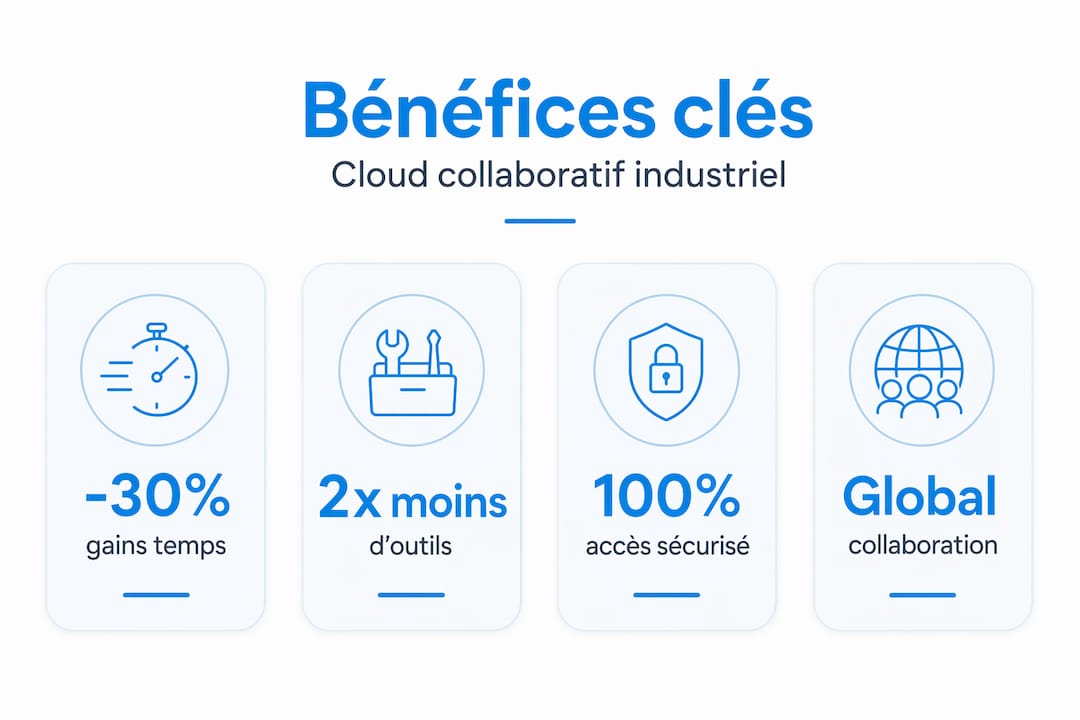
The most compelling example comes from the field. A case documented by BIMcollab illustrates how collaborative clash management went from 42 hours to 9 minutes thanks to a cloud platform structured around workflows and issues. This gain is not due to some magical technology. It comes from standardising processes and centralising data in real time.
Concrete operational benefits for your teams include:
- Simultaneous, multi-site access: several engineers can work on the same 3D model from different sites, without version conflicts or synchronisation delays.
- Report automation: automatic generation of post-meeting minutes reduces administrative workload and improves decision traceability.
- Cross-disciplinary coordination: greater project visibility enables mechanical, electronics, and simulation teams to work in parallel without waiting times.
- Role clarity: access rights and responsibilities are defined in the platform, preventing duplication and omissions.
Dassault Systèmes’ 3DEXPERIENCE platform illustrates this potential well: it provides global, real-time access without additional infrastructure investment, which is particularly suited to SMEs that cannot afford a dedicated IT department.
Pro tip: Before choosing your collaborative cloud solution, map your current inter-tool transitions precisely. They are what generate the most time loss and errors. Your cloud ROI will be directly proportional to the number of these transitions you eliminate.
Financial governance and cloud cost control
Adopting collaborative cloud without managing its costs is like turning on a tap without watching the water bill. The figures are clear: up to 35% of cloud spend can be wasted due to a lack of active resource management. For an industrial SME, this waste can quickly amount to tens of thousands of euros per year.

The paradox is that France shows strong overall cloud maturity. According to PwC, 87% of French companies report high cloud maturity, but only a 10% minority practise advanced FinOps management. In other words, most companies migrate to the cloud without putting in place the control mechanisms that secure their return on investment.
To avoid these pitfalls, here are the steps to build in from the start of your collaborative cloud project:
- Define financial KPIs from day one: cost per user, cost per project, monthly spend trends. Without a baseline, you cannot measure your gains.
- Enable automatic shutdown rules: test and simulation environments should shut down automatically outside working hours. This is one of the most common sources of waste.
- Implement regular rightsizing: your resource needs change depending on project phases. A quarterly audit of allocated versus consumed resources is a basic FinOps practice.
- Appoint a cloud owner: even in a 20-person SME, designating a cloud point person prevents the proliferation of ghost subscriptions and orphaned resources.
- Regularly compare SaaS offerings: the market evolves quickly. An annual review of your contracts can generate significant savings without changing tools.
Sustainable value creation in the cloud depends on alignment between technical architecture, business processes, and financial governance. This is not an IT issue. It is a business strategy issue.
Pro tip: Include a FinOps dashboard in your monthly reporting from the first month of deployment. Waiting until you have a cost problem to create it is always too late.
Data security, sovereignty, and compliance
Industrial 3D design generates extremely sensitive data: part drawings, assemblies, technical specifications, simulation results. This data is your intellectual property and, often, your competitive advantage. Protecting it in the cloud is not optional.
Modern collaborative cloud platforms address this challenge by centralising data and reducing tool fragmentation. According to a reference guide on cloud collaborative suites, centralising sensitive data facilitates both regulatory compliance and the security of multi-party exchanges. Fewer scattered file copies means a smaller attack surface.
The move towards sovereign cloud is accelerating in France. A concrete example: SAP RISE private Cloud Edition qualified SecNumCloud is being deployed in 2026 in partnership with S3NS and Thales, strengthening trust, compliance, and the confidentiality of industrial exchanges. This type of certification is becoming a must-have selection criterion for SMEs working with prime contractors in aerospace, defence, or automotive.
The concrete benefits of a certified sovereign cloud solution for your SME:
- Granular access-rights management: each partner, subcontractor, or customer accesses only the data relevant to them, with configurable rights (read, edit, export).
- Full traceability: every action on a file is timestamped and logged, making audits and dispute management easier.
- Built-in GDPR compliance: data remains on French or European territory, simplifying your compliance declaration.
- Easier partnerships: a demanding prime contractor will be able to share confidential specifications with you if your platform has the required certifications.
| Criterion | Standard cloud | Certified sovereign cloud |
|---|---|---|
| Data location | Variable (often outside the EU) | France or EU guaranteed |
| Security certification | Variable | SecNumCloud, ISO 27001 |
| GDPR compliance | Partial | Built-in |
| Access for sensitive prime contractors | Limited | Facilitated |
| Cost | Lower | Slightly higher |
To learn more about secure inter-company collaboration in 3DEXPERIENCE, licence-free sharing mechanisms are particularly well suited to SMEs collaborating with external partners. And if cybersecurity is a concern, it is useful to understand the most common attack vectors to better assess your real risks.
Choosing the right cloud platform for your industrial SME
Not all clouds are created equal, and the best collaborative cloud for your SME is not necessarily the most well-known or the cheapest. The choice depends on three factors: the sensitivity of your data, the size of your teams, and the complexity of your design workflows.
Here is a comparison of the main models:
| Model | Benefits | Limitations | Best suited to |
|---|---|---|---|
| Public cloud (SaaS) | Fast deployment, predictable cost, automatic updates | Less control over data | SMEs without ultra-sensitive data |
| Private cloud | Full control, maximum security | High cost, internal maintenance | Large companies or regulated sectors |
| Hybrid cloud | Flexibility, critical data on-premises | Management complexity | Growing SMEs with mixed data |
| Sovereign cloud | Regulatory compliance, trust from prime contractors | Still a limited offering | Defence and aerospace subcontractors |
For industrial SMEs and startups, the SaaS model in public or sovereign cloud is generally the most relevant. It requires no infrastructure investment, updates are automatic, and access is possible from any site. Cloud-based design with 3DEXPERIENCE illustrates this approach well: CATIA and SOLIDWORKS are accessible directly from the browser, with all collaborative features built in.
The selection criteria to assess in practical terms are compatibility with your existing CAD file formats, the quality of French-language technical support, pricing clarity, and the ability to scale up gradually. A solution that forces you to migrate all your files at once or train all your teams simultaneously creates an operational risk that few SMEs can absorb.
To explore the challenges of cloud integration for SMEs in more depth, it is useful to distinguish technical integration from organisational integration. The latter is often longer and more delicate than the former.
My perspective on cloud transformation in 3D industry
I have supported enough industrial SMEs in their digital transition to observe a recurring pattern: the leaders who succeed in adopting collaborative cloud are not those who chose the best technology. They are those who first clarified their processes.
What I have learned is that collaborative cloud is not an end in itself. It is a means to improve work structure and project management. Companies that move to the cloud without revisiting their workflows get disappointing results, because they have simply digitised their existing dysfunctions.
The most common mistake I see among leaders is delegating the cloud decision entirely to their IT manager or an integrator. Choosing a collaborative cloud solution for 3D design is a strategic decision that affects your competitiveness, your intellectual property, and your ability to collaborate with customers and partners. It deserves your direct attention.
What convinces me most is the tangible impact on product development cycles. When a team goes from 42 hours to 9 minutes to manage design conflicts, that is not a productivity gain. It is a transformation in how the team thinks and works together. And that is where the real competitiveness lever lies for French industrial SMEs.
My recommendation: start small, measure everything, and scale up gradually. A structured adoption with clear indicators is better than a large-scale rollout without benchmarks.
— Victor
Take Action with Ohmycad and 3DEXPERIENCE
You now have a clear view of the operational, financial, and security benefits of collaborative cloud in 3D design. The question is no longer “why adopt the cloud?” but “where should you start, concretely?”
At Ohmycad, we support industrial SMEs and startups in adopting the 3DEXPERIENCE platform in SaaS mode, with transparent pricing, gradual deployment, and expert French-language support. You benefit from SOLIDWORKS and CATIA directly in the cloud, with all collaborative features enabled from day one. No infrastructure to manage, no updates to schedule. Our team guides you from the discovery phase through to full adoption by your teams. Contact us for a personalised demonstration or consult our 3DEXPERIENCE mastery guide to get started on the right foot.
FAQ
What are the main benefits of collaborative cloud for an industrial SME?
The benefits of collaborative cloud include fewer coordination errors, simultaneous access to 3D models from multiple sites, report automation, and improved data traceability. These gains translate directly into shorter product development cycles and better cost control.
How can you avoid cloud-related budget overruns?
By implementing FinOps management from deployment: define financial KPIs, schedule automatic shutdowns for unused resources, and audit consumption every quarter. Without this governance, up to 35% of cloud spend can be wasted.
Is sovereign cloud necessary for an industrial SME?
Not systematically, but it becomes essential if you work with prime contractors in regulated sectors such as defence or aerospace. SecNumCloud certifications facilitate sensitive data exchanges and strengthen your partners’ trust.
What is the difference between simple cloud storage and collaborative cloud in 3D design?
Simple cloud stores files. Collaborative cloud structures workflows, manages role-based access rights, enables real-time co-editing, and automates cross-disciplinary coordination. It is this functional layer that generates measurable productivity gains.
How do I choose between the different cloud models for my SME?
Assess three criteria: the sensitivity of your data (sovereign cloud if data is critical), your ability to manage infrastructure (SaaS if you do not have a dedicated IT department), and your need for flexibility (hybrid cloud if your needs vary by project phase). The SaaS model in public or sovereign cloud suits the majority of industrial SMEs.