
AI & CAD: What SOLIDWORKS and CATIA are changing for designers.
Artificial intelligence is no longer a “plus” in CAD: it’s a new standard for productivity and quality. At Dassault Systèmes, SOLIDWORKS and CATIA are being enhanced with wizards and generative functions that are revolutionizing design, drawing, assembly and collaboration. Here’s a concrete overview – with our conviction as a common thread: for SMEs, ETIs and startups, SOLIDWORKS + 3DEXPERIENCE and CATIA today offer the best balance between speed, precision and product governance.
SOLIDWORKS Aura: The AI assistant that predicts your intentions.
At the workstation level, AI reduces friction: suggestions for orders at the right moment, automatic generation of sketches and 2D drawings from 3D, assembly assistance that limits errors in constraints and orientation. These are not gadgets: they are minutes saved with each gesture, which become hours on a project, then weeks on a product portfolio. At the last 3DEXPERIENCE World, SOLIDWORKS presented AI capabilities of this kind, and an assistant called SolidWorks AURA (in beta) aimed at predicting user intent and automating repetitive tasks.
Why industrial startups must embrace AI-assisted CAD.
In concrete terms, the new AI features announced and demonstrated around SOLIDWORKS relate to :
- Suggested commands (prediction of the “next move”),
- Automatic generation of drawings from the model, with entity and constraint detection,
- Accelerated assembly (reduced manual selection and matching).
Objective: less searching, more designing. For design offices under pressure, this cumulative effect is decisive. And in the 3DEXPERIENCE Works ecosystem, these aids are aligned with data management, simulation and manufacturing to avoid “configuration debt”.
CATIA & 3DEXPERIENCE: AI for generative design… and governance
On complex products (aeronautics, mobility, special machines), AI with CATIA software is expressed above all through generative design and virtualization of the digital twin:
- Performance-driven generation/topology to explore thousands of alternatives at an early stage, integrating materials, processes and sustainability constraints;
- Visual Scripting (no-code) to “program” complex geometries and patterns, speed up iterations and standardize in-house know-how;
- 3DEXPERIENCE governance: a digital thread where AI serves as a gas pedal (e.g. search, classification, recommendations) while respecting IP and traceability.
In the ” 3D UNIV+RSES “vision put forward by Dassault Systèmes, AI is supported by virtual twins, and aims to create generative experiences “for everyone, on everything”. In other words, not only do we automate CAD gestures, but we also increase product architecture choices, module reuse, and extended collaboration with the supply-chain.
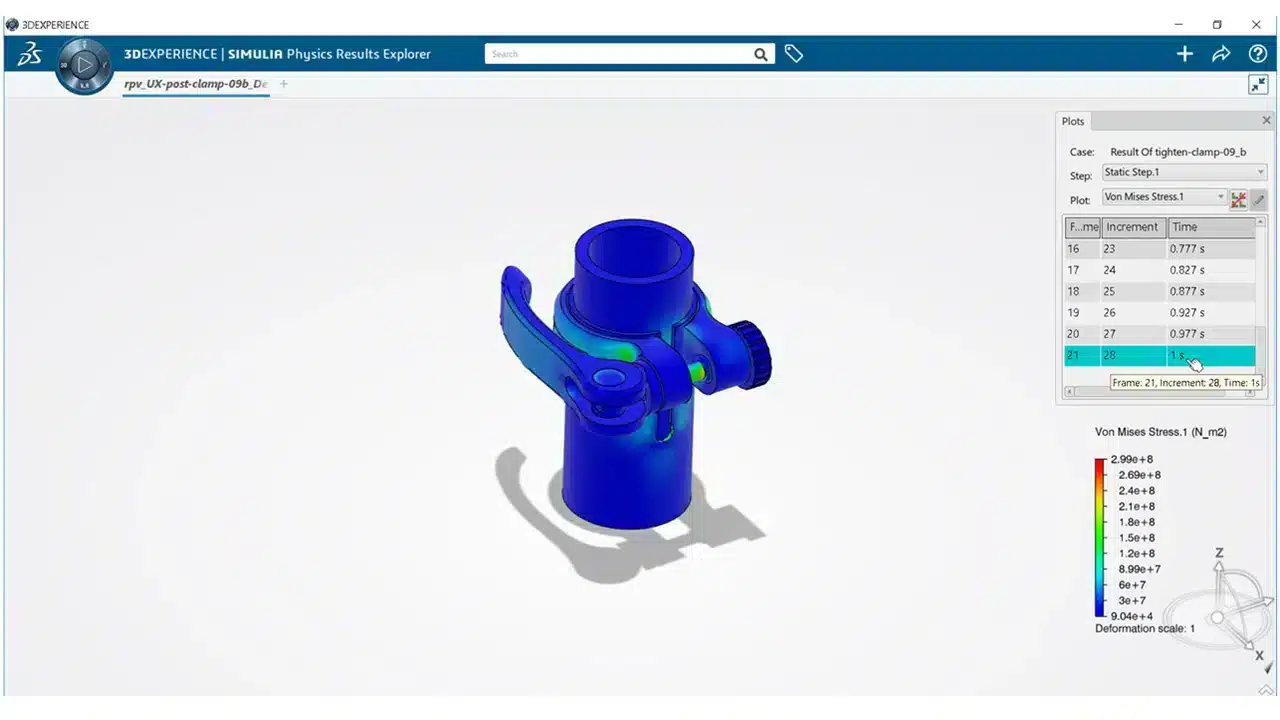
CATIA leverages AI for generative design, optimized topology and PLM governance.
Visit https://hub.ohmycad.com/en/liste-de-prix-officielle-catia to anticipate your investments.
What this means for designers
- Fewer clicks, more intent: anti-friction AI (suggestions, contextual search, synthesized commands) reduces tool navigation time.
- Better “first pass”: drawings, assemblies and variants generated quickly, which the engineer then refines with his expertise.
- Document quality: automated drawings, with better constraints, reduce deviations and speed up production start-up and inspection.
…and for industrial startups
Start-ups need to move fast without compromising quality or IP. The AI assistants in SOLIDWORKS provide a shorter time-to-prototype, while CATIA enables exploration of lightweight architectures (topology, multi-materials) compatible with targeted manufacturing channels.
The real game changers for industrial startups are the reduction in technical debt and considerable prototyping time.
With 3DEXPERIENCE, we keep the PLM backbone in place from day 1 (traceability, versions, requirements), so we don’t have to “pay” the data debt later.
For startups, PLM integration via 3DEXPERIENCE is key. If you’re having connection problems, here are our guides:
Yes, the competition is on the move – and that’s good news.
- Autodesk advances a banner ” Autodesk AI ” banner and is multiplying use cases around creativity, automation and predictive analysis (with Fusion sessions dedicated to AI). This is stimulating for the market… but CAD ↔ PDM/PLM ↔ MFG coherence remains the knot to be solved on a large scale.
- PTC/Creo capitalizes on generative design (GTO/GDX) and now communicates a “workflow-embedded” GenAI strategy. Relevant for accelerating certain studies, butend-to-end integration with advanced simulation and multi-trade governance remains the main arena.
- Siemens NX has long been pushingAdaptive UI (ML), and has announced an AI Chat Copilot for NX X Essentials, in addition to joint work with Microsoft on industrial copilots. Here again, the trend is confirmed: AI is becoming the natural interface for CAD. Our position is clear: for organizations that want immediate productivity (SOLIDWORKS ) + a controlled increase in complexity (CATIA ) + 3DEXPERIENCE governance, the Dassault Systèmes ecosystem is the most coherent today – from the engineer’s workstation to the supply chain and virtual factory twins.
How to make a successful “step towards AI” in CAD (4-step method)
- Map your high-frequency processes (drawing, assembly, searches, bills of materials) to target the first AI gains.
- PLM framework from the outset: versions, requirements, rights, data security – especially in a startup/partner context.
- Scenario-based training: task-oriented micro-workshops (auto-drawing, assisted assembly, generative variants) with measurable objectives.
- Continuous improvement loop: choose 3 KPIs (e.g. drawing time, assembly errors, part reuse) and iterate in sprints.
8 key AI features in SOLIDWORKS 2026
- Command Predictor: anticipates the tools you’ll use next, with a dynamic suggestion bar (up to 7 commands).
- AI-Driven Generative Drawings: automatic generation of 2D drawings from 3D models, with customizable options.
- Smart Insert Component: recognition of standard components (bolts, screws) and automatic application of constraints(mates).
- AI-Driven Image to Sketch: convert images into sketches with automatic constraints and dimensions (ideal for reverse engineering).
- Generative Assembly: automatic creation of complete assemblies after a few parameters.
- Generative 3D Part: transform a photo into a precise 3D model (virtual twin).
- Generative Stacked Dimensions: automatic addition of dimensions and constraints when sketching.
- Generative NC Machining: optimize machining paths and CNC parameters to reduce time and waste
source: 8 Key Features Demonstrating the Power of AI in SOLIDWORKS 2025 – Engineers Rule
Where Ohmycad can help: Productivity gains > Fewer repetitive tasks, more creativity.
- IA-CAO express audit (2 weeks): identification of actions to be automated, prioritization of use cases, SOLIDWORKS/3DEXPERIENCE/CATIA roadmap.
- Guided drivers: AURA & co on the SOLIDWORKS side; generative design and Visual Scripting on the CATIA side; 3DEXPERIENCE PLM integration for traceability.
- Acculturation and change: professional training (designers, product managers, methods) and coaching on real data.
Our approach is simple: speed up without sacrificing quality orIP.(Contact us – Ohmycad – for a free 30-minute diagnosis).
Sources & useful links
- Dassault Systèmes – 3DEXPERIENCE World 2025 (official announcement, “generative AI capabilities”, keynote speeches) : Newsroom DS
- Demonstrations & analysis of new AI features in SOLIDWORKS (suggestions, drawings, assemblies, AURA wizard): Digital Engineering 24/7, EngineersRule
- CATIA – AI-Driven Generative Experiences (generative design, performance, reuse) : 3ds.com – CATIA & AI; Vision Virtual Twin & 3D UNIV+RSES: Design-Engineering, 3DS Blog CATIA
- Panorama competition :
- Autodesk – Autodesk AI (platform, vision Design & Make) + Fusion 2025 sessions: Press Release, AU 2025 sessions
- PTC/Creo – generative (GTO/GDX) & embedded GenAI strategy: PTC (tech/generative), PTC blog (GenAI strategy)
- Siemens NX – Adaptive UI & AI Chat Copilot: Adaptive UI, NX X Essentials – AI Copilot
- All
- Buying locally
- Catia
- Cloud
- compatibility
- free license
- Free license
- Free Trial
- Low cost
- Solidworks
- Startup
- startup
- Subscription
- technical support
CATIA V5 is the legacy version, installed locally. CATIA 3DEXPERIENCE is the cloud version, integrated into a collaborative platform that centralizes data, roles, and business processes. It enables digital continuity and greater agility.
Self-learning modules, a resource center & technical knowledge base, certified training, and online courses are available via Dassault Systèmes and its partners such as Ohmycad.
Yes! Contrary to popular belief, CATIA is accessible to small structures, thanks to flexible cloud offers and targeted business roles. Ohmycad supports startups in their adoption of CATIA with training, support and tailored offers.
The CATIA solution enables you to design parts and products with great precision, thanks to advanced parametric and surface modeling, perfectly suited to complex mechanical design projects. It also facilitates the creation and management of complex assemblies, offering powerful tools for structuring, verifying and evolving multi-component assemblies. Kinematic and dynamic simulation functionalities enable the behavior of mechanisms to be analyzed, movements to be validated and performance to be anticipated right from the design phase. The design of sheet metal parts, plastics and industrial molds is supported by dedicated tools designed for industrialization and manufacturing. Native integration with the 3DEXPERIENCE platform connects design, simulation and data management in a single environment. Finally, cloud collaboration combined with centralized product data management (PDM) ensures efficient, secure, real-time collaboration between all teams. Ohmycad experts recommend upgrading from CATIA V5 to CATIA 3DEXPERIENCE to benefit from the full power of the cloud-based tool.
CATIA is designed for engineers, designers, project managers and manufacturers who need a robust, collaborative and scalable design environment. It is used by large corporations as well as SMEs and innovative start-ups. Ohmycad offers a startup program to make industrial software accessible even to cash-poor companies, and provides free access to CATIA for 1 year (with no commitment). Users are often former users of software such as Solidworks who find themselves technically limited when it comes to technical design.
CATIA (Computer-Aided Three-dimensional Interactive Application) is a 3D CAD software developed by Dassault Systèmes. It is used to design, model and simulate complex products in a wide range of sectors, including aerospace, automotive, energy and architecture. It is renowned for its geometric precision and modeling power. CATIA is the CAD software of choice when your design assemblies are getting too heavy for tools such as Solidworks or Autocad, Fusion or Solidedge.
After theSolidWorks trial, depending on your needs (number of users, modules, offline/cloud constraints, PDM flow) we align a SolidWorks 2026 pricing offer adapted to your structure and usage (subscription vs. perpetual). The aim: to reduce your total cost of ownership and secure your time-to-production.
With Ohmycad, you can install locally, work with older Solidworks versions, multiply workstations (depending on licenses), collaborate via links to share your 3Ds, and add Simulation/PDM/Render as needed. Best practices in the Knowledge Base and blog. Test Solidworks free of charge!
If your company has an active license, you are entitled to certification vouchers (CSWA/CSWP…) twice a year. The Ohmycad tutorial explains how to create accounts, collect vouchers and prepare for exams.
With Ohmycad, you can install locally, work with older versions, multiply workstations (depending on licenses), collaborate via links to share your 3D, and add Simulation/PDM/Render as needed. Best practices in the KB and blog.
Avoid cracks and dubious sites: beyond the legal risks, they expose you to malware, data loss and lack of support. Prefer legal channels: free trial, Solidworks for Startup program, education versions if eligible – you stay compliant and productive. (Reinforce E-E-A-T in the article with this warning).
Start with the 24-hour online test to validate environment and performance, then request an evaluation key if required (longer scenarios, real files, import/export tests, Simulation). Ohmycad offers a quick audit to set objectives and metrics before purchase.
Yes, for individuals/students and corporate customers. For companies (startups, SMEs),solidworks are purchased via certified partners (such as Ohmycad), who provide guidance, configuration and support (licenses, modules, deployment).
Download the official installer from SOLIDWORKS, connect the 3DEXPERIENCE ID, accept the contract, choose the appropriate Service Pack, then follow the wizard (check disk space, serial number(s)). For multiple deployments: admin images via the manager. Step-by-step guide in the Ohmycad Knowledge Base.
Yes, current licenses integrate Dassault Systèmes’ Outscale cloud infrastructure (SecNumCloud/ISO 27001), but you can install locally, work offline, and remain compatible with earlier versions as required. With Ohmycad, you can test Solidworks free of charge for a few days!
Yes, SOLIDWORKS Student (via schools or individual offers) is offered by Dassault Systèmes. For professional or startup use, opt for the free trial and/or the Solidworks for Startup program piloted by Ohmycad. (Please note the target audience on the page to avoid licensing confusion).
Yes: year 1 on SOLIDWORKS free of charge (and -90% on apps), then -70% year 2, -50% year 3, subject to eligibility (start-ups, admission criteria, etc.). The program includes support (CAD/PDM project manager, support, training) and is non-binding. This is the recommended route for early-stage startups.
Yes, in specific cases: via thefree trial (24-hour online access, followed by a temporary key), and via the Solidworks for Startup program (year 1 free under certain conditions), in official partnership with Dassault Systèmes. In all other cases, “free” access does not comply with licensing requirements and may expose you to legal and security risks. To test in good standing: free trial, then personalized evaluation according to your use.
Ohmycad offers a 24-houronline solidworks test (full functionality). Depending on returns, a temporary ~15-day key can be issued. All you have to do is enter your pro details, then access the test environment. It’s the official, fast way to evaluate performance, with no obligation.
All data is stored in Dassault Systèmes datacenters in Yvelines, France.